
Massage Chair Buying Guide 2026: How to Choose
If you are searching for a massage chair buying guide, you have probably already noticed how little the spec sheets tell you. Two chairs can list the same track length, the same roller count, and the same zero-gravity recline, yet feel completely different on your back. That gap between what a brochure promises and what your shoulders actually receive is where most buying decisions go wrong.
This guide closes that gap. Instead of ranking features in the abstract, it explains how each one changes the massage you feel: how rollers move, how body scanning adjusts pressure, how track design decides which muscles get reached, and where your money genuinely goes. You will finish with a practical checklist for matching a chair to your body, your daily strain, and your budget, so the model you choose is one you keep using rather than one you merely own.
Key takeaways
- Match the chair to your body first: body scanning to match your shoulder height and adjustable intensity matter more than a long feature list.
- Track type and roller dimension (2D, 3D, 4D) determine how much of your back and legs get massaged and how deep it feels.
- Zero gravity, lumbar heat, and foot reflexology are the features most tied to real pain relief and relaxation.
- Budget for long-term investment, not just the sticker price, since a massage chair is a 3-10 year investment.
- Test the lowest and highest intensity settings before buying; a good massage chair should feel both gentle and therapeutic.
What Is a Massage Chair and Why It Matters in 2026
What defines a modern massage chair? It is a programmable, full-body massage system engineered to replicate the nuanced techniques of a professional human therapist. These devices utilize an array of components—including advanced rollers, precisely placed airbags, and targeted heat—to simulate complex motions such as shiatsu, kneading, and stretching.
The perception of these chairs has shifted significantly. They are no longer viewed merely as a luxury novelty; they are increasingly recognized as a vital lifestyle investment in personal wellness. With the rising cost and limited availability of frequent professional spa visits, and given the prevalence of everyday physical strain, many individuals are seeking reliable relief at home.
How Massage Chairs Differ From Massagers and Spa Visits
The distinction lies in the complexity of the experience. Simple massagers often deliver generalized vibration. In contrast, premium systems are designed to work the muscles with specific, dynamic movements. This is where advanced technology provides a tangible difference. For instance, an OSIM massage chair does not simply vibrate; its programs are designed by Japanese chiropractic massage experts to mimic the precise actions of a human therapist.
Furthermore, the credibility of these devices is supported by professional recognition. OSIM is the only massage chair brand endorsed by the American Chiropractic Association (ACA) for spinal health benefits. This endorsement serves as a significant credential when evaluating the therapeutic potential of a device.
Who Gets the Most Value From a Massage Chair
Several specific groups stand to gain substantial value from incorporating this technology into their daily routine.
- Regular Therapy Clients: Those who frequently see a massage therapist can enjoy that level of care daily.
- Office Professionals: Individuals experiencing tension from prolonged periods of desk work benefit greatly from targeted relief.
- Seniors and Wellness Seekers: Those managing daily aches or seeking preventative care appreciate the convenience of at-home wellness.
When considering this investment, one must look beyond simple vibration. Modern massage chairs offer features like body scanning to detect body shape to adjust the roller shoulder height and width, and zero gravity positioning to promote deeper relaxation. Do you need a tool to help relieve the everyday strain of modern life?
How Massage Chairs Work: Rollers, Tracks, and Body Scanning
A massage chair is not a padded seat with a vibration motor. Inside the backrest sits a carriage of mechanical rollers that travel along a track, pressing into muscle the way a therapist's hands do. Everything else—airbags, heat, body scanning—supports that core mechanism. Understanding these four components tells you more about a chair than any feature list.
2D vs 3D vs 4D: What the Numbers Mean
The numbers describe how many directions the rollers can move.
- 2D rollers move up and down your back and side to side. The depth of the press is fixed.
- 3D adds a third axis: the rollers extend outward into your back, so intensity becomes adjustable.
- 4D adds variable speed and rhythm on top of 3D. The rollers slow, pause, and accelerate, which is what makes a program feel like hands rather than a machine.
Massage chair technologies are generally classified as 2D, 3D, or 4D based on their roller movement, depth adjustment, and massage speed variations. Terms such as 5D, 6D, 7D, 8D or higher are not standardized industry classifications and are often used as marketing terminology to describe additional features, such as ambient lighting, built-in speakers, or other comfort enhancements, rather than fundamentally different massage roller technologies. When comparing massage chairs, focus on the actual massage mechanisms, roller capabilities, track design, and overall massage performance instead of relying solely on higher “D” ratings.
For a closer look at how these mechanisms are engineered, see our guide to massage chair technology.
Tracks, Airbags, and Heat
The massage track determines how far the massage rollers can travel along your body, directly influencing massage coverage and the overall experience.
- S-track: Follows the natural curvature of the spine, delivering targeted massage from the neck and shoulders to the lower back.
- L-track: Extends the roller pathway beyond the lower back to reach the glutes and upper hamstrings, providing more extensive lower-body massage coverage.
- SL-track: Combines the spine-contouring design of an S-Track with the extended coverage of an L-Track, allowing continuous roller massage from the neck and shoulders down to the glutes.
- Dual SL-Track: Features two coordinated massage roller mechanisms operating along separate track sections, enabling more targeted massage of the upper back and lower back, hips, and glutes. This design can deliver simultaneous massage to multiple body regions for a more comprehensive experience.
Beyond roller technology, airbag compression systems provide rhythmic pressure to areas such as the arms, calves, and feet, helping promote relaxation and temporarily support circulation. Built-in heat therapy and lumbar massage functions provide additional comfort to the lower back, making them particularly appealing to individuals experiencing muscle tightness or stiffness after prolonged sitting. When comparing massage chairs, consider not just the track design but also the roller technology, massage intensity, body coverage, and synchronization of different massage mechanisms. These factors collectively determine the quality and effectiveness of the massage experience.
Why Body Scanning Matters for Shorter and Taller Users
Before a program begins, sensors map your shoulder position and adjust to it. The chair then adjusts roller position and intensity to your frame. Without this step, a fixed roller path lands in the wrong place on most bodies. During a session in the uDream·AI, that scan can also feeds a personalized wellness analysis, so the program reflects your body rather than an average one.
Ask yourself: does the chair adapt to you, or do you have to adapt to the chair?
Key Features to Compare Before You Buy
Once you understand rollers and tracks, the next step is comparing the features that shape your daily experience. These are the details that separate a chair you use occasionally from one you rely on.
Zero gravity recline raises your legs above heart level, which decompresses the spine and deepens relaxation. It is one of the most requested features for good reason: the position redistributes body weight and lets the rollers work with less resistance from your muscles.
Techniques That Mimic Human Hands
Look beyond vibration. A real massage kneads, presses, and stretches tissue. Compare chairs on the techniques they offer:
- Shiatsu and kneading for deep muscle work
- Tapping and rolling for lighter, rhythmic relief
- Specialty programs such as Tui-Na gliding massage and V-Hand shoulder grip
The lifestyle programs on OSIM massage chairs are designed by Japanese chiropractic massage experts, and the uLove3 pairs V-Hand Plus with 4-Hand Plus for a more therapist-like feel.
Foot and Calf Reflexology: Small Feature, Big Difference
Targeted relief features matter if you have specific pain points. Lumbar heat soothes lower-back tightness, shoulder grip reaches the trapezius, and foot reflexology rollers work pressure points in the soles.
| Feature | What It Does | Who Benefits Most |
|---|---|---|
| Zero gravity | Decompresses spine, raises legs | Lower-back strain, poor circulation |
| Lumbar heat | Warms and relaxes the lower back | Stiffness, cold-weather discomfort |
| Foot reflexology | Stimulates sole pressure points | Standing jobs, tired feet |
| Shoulder grip | Pinpoints trapezius tension | Desk workers, neck tightness |
Finally, check controls and connectivity: remote, touchscreen, voice, and app-based updates. Then measure wall clearance and door width before ordering.
Matching a Chair to Your Body and Pain Points
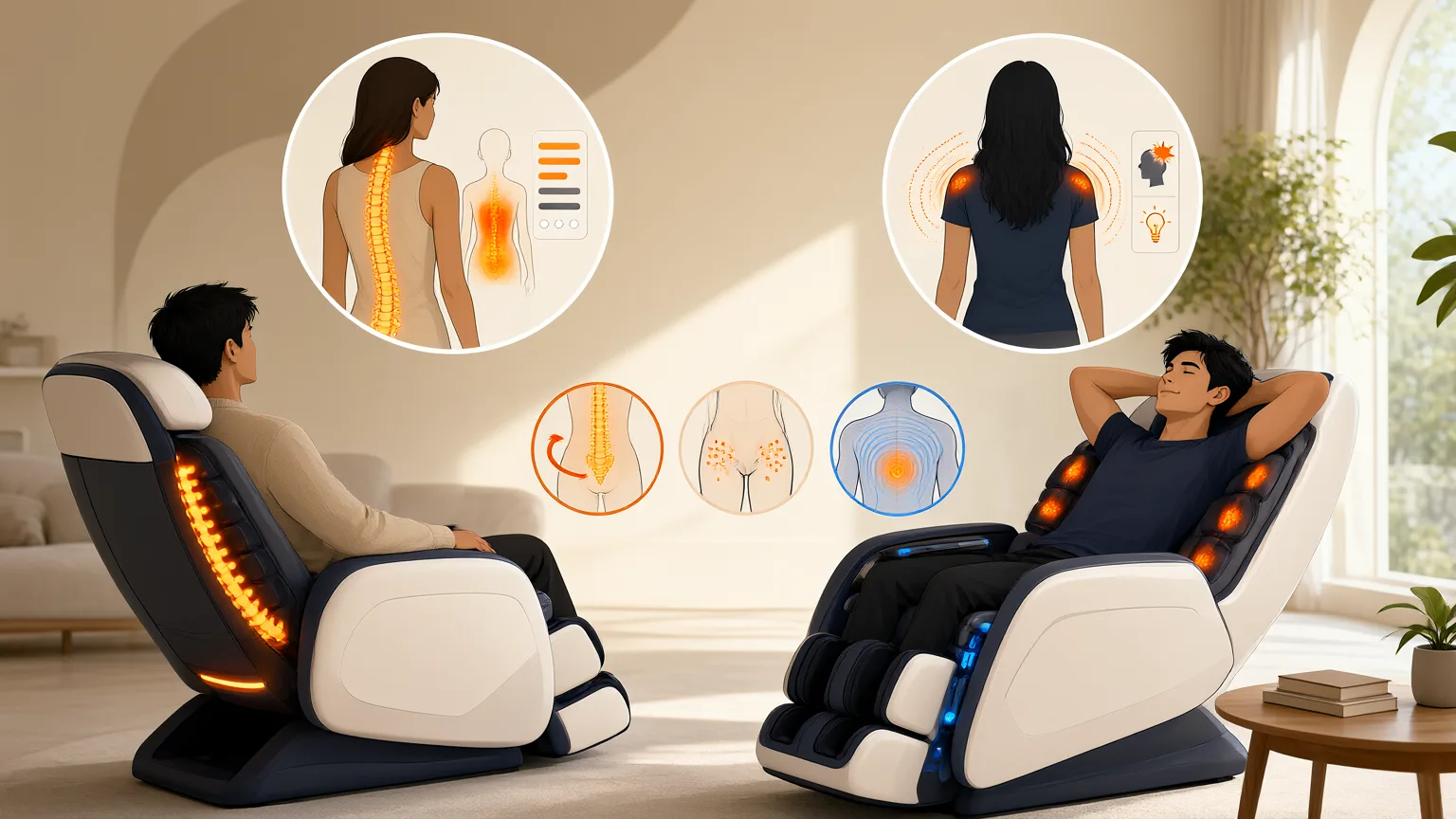
No single chair fits every body. The right match depends on where you carry tension, how you use your body daily, and who else will sit in the chair. Start by identifying your primary complaint, then match it to the features that address it.
Back and neck pain: Prioritize an SL-track, which follows the spine's curve and extends down through the glutes. Add heat therapy and adjustable intensity with body scanning, so the rollers find your pressure points rather than guessing.
Desk workers: Look for shoulder and upper back coverage. V-Hand™ Shoulder Grip targets the exact spots that hunch over a keyboard. Programs for tension headaches and posture support help undo a day of sitting.
Seniors: Easy entry matters as much as massage quality. Choose slower speed settings and gentle airbag compression, which coax circulation without aggressive pressure.
Athletes and active users: Deeper 4D rollers reach muscle layers that lighter mechanisms skim. Recovery-focused programs support the cool-down your training week demands.
Couples and shared households: Memory presets and auto-detection let each person get a consistent massage without readjusting settings every time.
If You See a Massage Therapist Regularly
You already know what good bodywork feels like. A massage chair should reproduce that standard daily, not approximate it. OSIM programs are designed by Japanese chiropractic massage experts to knead, press, and stretch the way a therapist does. The uDream·AI, for example, combines Shiatsu, Tui Na, Thai Stretch, and Balinese techniques in one chair, so the massage you pay for weekly becomes available every evening.
If You Want Relaxation More Than Therapy
Your priority is unwinding, not targeting a specific injury. Focus on comfort features: Zero Gravity reclining, warmth therapy, and audio or aromatherapy that signal your body to slow down. The uDeluxe Max pairs 3D massage with extended SL-track coverage and warmth for exactly this purpose.
Ask yourself which description fits you best. That answer narrows the field faster than any specification sheet.
Entry-Level vs Mid-Range vs Premium: What Changes
Entry-level chairs typically use basic roller mechanisms, shorter tracks, and simpler programs, offering relaxation-focused massage rather than precise, therapist-like technique. Mid-range chairs typically add stronger motors, longer SL tracks, body scanning, and zero-gravity positioning, which is where chairs start to feel genuinely personalized. Premium chairs typically add 4D rollers with variable speed and depth, advanced scanning, and premium materials, so you are paying for precision and durability, not just extra features.
Several factors drive the price: roller technology, track length, motor quality, upholstery, and the depth of the program library. As a general reference point, capable full-feature chairs commonly sit in the four-figure range and above.
Warranty Terms Worth Reading Closely
A massage chair is a long-term purchase, so compare coverage line by line:
- Parts/structures: How long are rollers, motors, and electronics covered?
- Labor: Is repair work included, or do you pay hourly?
- In-home service: Will a technician come to you, or must you ship a 200-pound chair?
OSIM USA provides a 3-year limited warranty on its massage chairs, for items purchased through official OSIM sales channels in the United States, offering added peace of mind and long-term confidence in your investment. For added convenience, OSIM also offers professional in-home servicing included in the warranty, where a certified service technician visits your location to inspect, diagnose, and service your massage chair, eliminating the hassle of transporting a large, heavy chair to a service centre.
Financing and Maintenance
Many brands offer 0% financing, which affects total value as much as the price itself. Plan for upkeep too: wipe down upholstery regularly, install firmware updates, and keep the chair in a climate-controlled room to protect motors and materials.
How to Test and Choose: A Practical Checklist
A massage chair is a lifestyle investment, so the final step is verification. Whether you visit a showroom or buy online, use the checklist below to confirm the chair fits your body, your comfort level, and your expectations.
Questions to Ask Before You Buy
- Can I sit in it first? If you have a showroom nearby, book a session. OSIM operates showrooms in Arcadia, Brea, San Francisco, and Santa Clara, California, and occasional pop-up roadshows across the United States where you can test the rollers before committing.
- Does the body scan land correctly? The scan should place rollers on your neck and shoulders, not too high or too low. If the mechanism sits above your shoulders or misses your lumbar curve, the massage will feel generic.
- Is the zero gravity recline comfortable to enter and exit? Recline fully, then get out. If you need help standing, the chair is not the right fit.
- Does the intensity range work for you? The lowest setting should feel relaxing; the highest should feel therapeutic, never painful.
- Who stands behind it? Look for decades of expertise, professional-association recognition, and responsive customer service. OSIM, for example, is the only massage chair brand endorsed by the American Chiropractic Association and offers a three-year limited warranty.
Frequently asked questions
What should I look for in a massage chair in 2026?
Start with the massage mechanism, not the price tag. Look for 3D or 4D rollers, an SL track that follows your spine, body scanning, and Zero Gravity reclining. Then check the warranty and whether the brand's programs were engineered with professional input, such as the Japanese chiropractic-designed routines found in OSIM massage chairs.
How much should I expect to spend on a quality massage chair?
Expect a wide range. Entry premium full-body chairs sit at the lower end, while advanced luxury models with AI wellness analysis, immersive audio, and aromatherapy cost considerably more. Treat it as a lifestyle investment measured over years of daily use, not a one-time gadget purchase.
Is a massage chair worth it compared to regular massage therapy?
If you see a massage therapist regularly, a chair lets you have that massage every day at home. You avoid scheduling, travel, and per-session costs. The trade-off is upfront price and space. For people managing everyday strain, daily convenience often outweighs occasional appointments.
How do I know if a massage chair is actually good quality?
Check credentials, not marketing. Look for third-party recognition, design awards, patents on the massage technology, and warranty length. OSIM, for example, is the only massage chair brand endorsed by the American Chiropractic Association and has won multiple global Awards with its line of massage chairs and portable massagers.
Final thoughts
The right massage chair is not the one with the longest feature list. It is the one whose rollers, programs and positioning match how your body actually carries strain. Prioritize authentic massage mechanics, credible engineering and professional-association recognition over novelty features.
The most reliable way to choose is to test a massage chair in person. Visit an OSIM showroom in Arcadia, Brea, San Francisco, or Santa Clara to compare models and experience the difference between simple rollers and targeted kneading, pressing, and stretching. Bring your own tension points, test the programs that matter to you, and let your back make the decision.

